
Conversations with the School
At School Resources
At Home Resources
The Individual Education Plan (IEP) in Ontario
An Individual Education Plan (IEP) is a written plan for a student who requires special education programs or services.
In Ontario, an IEP is a key component of the special education process, outlining a student’s strengths, needs, and the specific supports the school board will provide to help them achieve their learning goals. It may include accommodations, modifications, and essential teaching strategies. It’s a legal document that is developed to increase a student’s successful access to curriculum and participation in the classroom.
An IEP is developed by a team that includes the student’s parents or guardians, classroom teachers school administrators, and other professionals (e.g., school board psychologist, speech-language pathologist). Families are a crucial part of the IEP team, as they always know the most about a student.
An IEP is not the same as a diagnosis. Your child can have an IEP without an assessment or diagnosis. The IEP should describe your child’s learning strengths, needs, goals, and the supports that will be provided to ensure success.
Learn More

Preparing for the IPRC Meeting
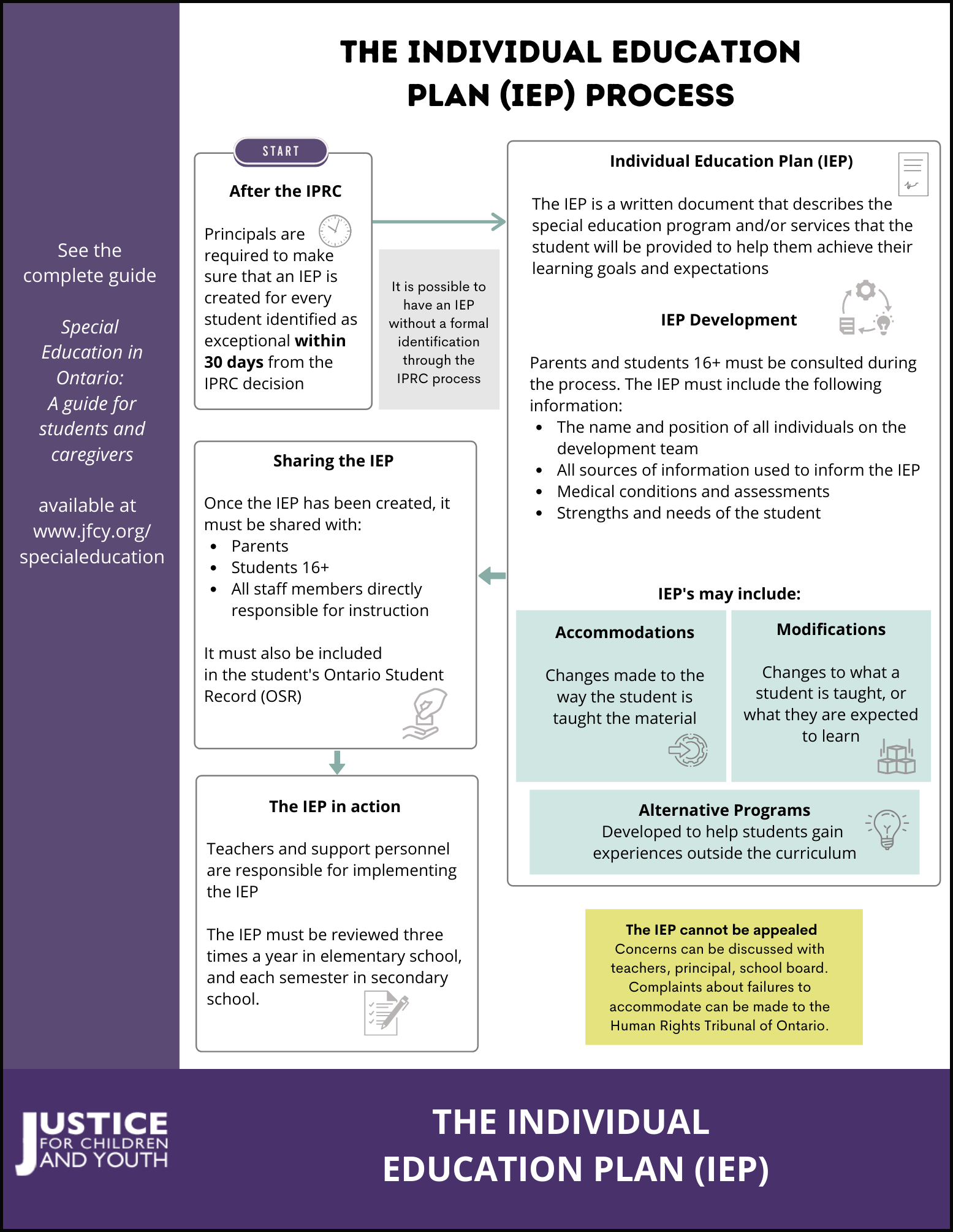
The Individual Education Plan Process
The Identification, Placement, Review Committee (IPRC)
THE IPRC decides placement, and identification of a student. School boards must provide special education programs and services to students who are formally identified as “exceptional pupils.”
Action
In Ontario, a standard IEP template includes the following sections:
- Student Profile: This section outlines your child's strengths, learning preferences, and any specific diagnoses or exceptionalities identified through an Identification, Placement, and Review Committee (IPRC).
Accommodations and/or Modifications:
- Accommodations are changes to how a student learns or is assessed, but they don't change the curriculum expectations (e.g., providing a scribe, extended time for tests, a quiet space).
- Modifications are changes to the grade-level expectations for a subject (e.g., a student in Grade 5 might work on math expectations from a Grade 3 curriculum or have reduced expectations or complexity).
Learning Goals:
These are specific, measurable goals that your child will work toward over the school year. They are created based on the student’s strengths and needs.
- Special Education Program and Services: This lists the specific programs and services your child will receive, such as instruction from a special education teacher, speech and language therapy, or access to a resource room.
- Transition Plan: An essential part of every IEP, this section plans for transitions between grades, schools, or from school to work, post-secondary education, or community living. For students aged 14 and older, this section must include goals related to their post-secondary pathways.
The Ontario Ministry of Education is the primary source for information on special education policy, including the IEP.
All students with learning disabilities can receive support through accommodations to help them access curriculum and demonstrate their learning.
These supports are documented in the student’s Individual Education Plan (IEP) and are based on individual needs. These accommodations are not supports that are offered to all students in a class. Instead they are the necessary supports and tools provided to an individual student to enable them to demonstrate their full potential when accessing curriculum.
Three Types of Accommodations
Instructional – Changes to how teaching happens
- Examples: Breaking tasks into smaller steps, using visual aids, giving instructions verbally and in writing
Environmental – Changes to where and under what conditions learning happens
- Examples: Quiet work area, preferred seating, reducing background noise
Assessment – Changes to how a student shows what they know
- Examples: Extra time, oral responses instead of written ones, use of assistive technology.
Examples of Classroom Accommodations
Accommodations are changes in how a student learns or shows what they know — not in what they are expected to learn in each grade. Examples include:
- Extra time to complete tests, assignments, and tasks
- Oral instructions instead of written ones, or a combination of both
- Assistive technology such as text-to-speech software, speech-to-text programs, or audiobooks
- Alternate assignments that allow a student to present knowledge in different formats (e.g., a video presentation instead of a written essay)
- Assignments or tasks chunked into smaller steps
- View a list of examples from the Ministry of Education
Accommodations vs. Modifications
Accommodations: Support how a student learns the same curriculum expectations as their peers.
Modifications: A change to the grade-level learning expectations a student is taught. This differs from the curriculum other students in the same grade are learning (e.g., working on a lower grade-level curriculum in one or more subjects). When a curriculum expectation is modified, an individualized expectation is included in the IEP.
Modifications should be introduced with caution, and only when absolutely necessary, as they can affect future outcomes and pathways.
The Ontario Human Rights Commission stated in the Right to Read Inquiry Report
“Schools should modify to lower grade-level expectations only as a last resort – and only after making every effort to provide interventions and successfully accommodate the student’s learning needs to attain grade-level expectations.”
Checklist: Questions to Ask About IEPs
When you look at your child’s IEP, you might consider:
- The IEP should indicate consistent supports for your child. Are the accommodations provided on a daily basis? What will work best for my child to demonstrate their knowledge?
- Are the accommodations provided for both in-class work and assessments?
- In reviewing accommodations, consider what is the most effective way for your child to demonstrate their knowledge (e.g., extra time, assessed with an alternative to written output).
- Which accommodations are provided for which class or subject?
- How is the effectiveness of the accommodations monitored? Accommodations that are not being used or are not successful for your child can be removed from the IEP. It is better to have fewer accommodations that are specific and precise.
- If the IEP includes modifications, what is the plan to build skills to close the gap until my child can work on regular grade expectations? How is the progression towards the goals being monitored?
- Further Reading: Dyslexia Canada Parent Handbook